Mission editor · planned for the full version
Write a simulator program with the AI
In the full version of IKAREE you will be able to write your own mission without programming. You talk it through with an AI here on the website, it builds the mission from the parts the game already knows, and once the game's author approves it, it appears aboard the IKAREE as a simulator program that other captains can play.
New: create an alien species for the Living Universe, a shared world of player species on real exoplanets.
Link your headset
Not open yet. The editor opens here with the full version of IKAREE. You will find your code in the game under Menu → Simulator Editor → Link web editor.
- Status
- Planned for the full version
- Where
- Here, at ikaree.space/editor
- Who can write
- Owners of the game
- Programming
- None, you talk to an AI
- Language
- English or Czech
- In the game
- Simulator programs
How you write a program
- The idea. One sentence about your mission, and a length: 20, 30 or 45 minutes.
- The conversation. The AI walks you through the shape every IKAREE mission has: the routine, the trigger, the captain's options, the arrival, the investigation, the twist, the turning point, the endings and the log. It offers choices; you pick one or write your own.
- The mission card. Next to the chat a live card shows the title, the open questions, the clock, the characters, the endings and what is still missing. You never see code.
- The check. The same automatic checks and test runs that check our own missions run on yours. The AI explains what they found in plain words and suggests a fix.
- A test flight. The AI plays your mission with you as a text adventure, following the real game logic, with you as the captain. Optional, but worth it.
- Submit. Once the checks pass, you accept the author terms and send it.
- The answer. Approved, returned with a note, or declined. A returned program can be fixed and sent again.
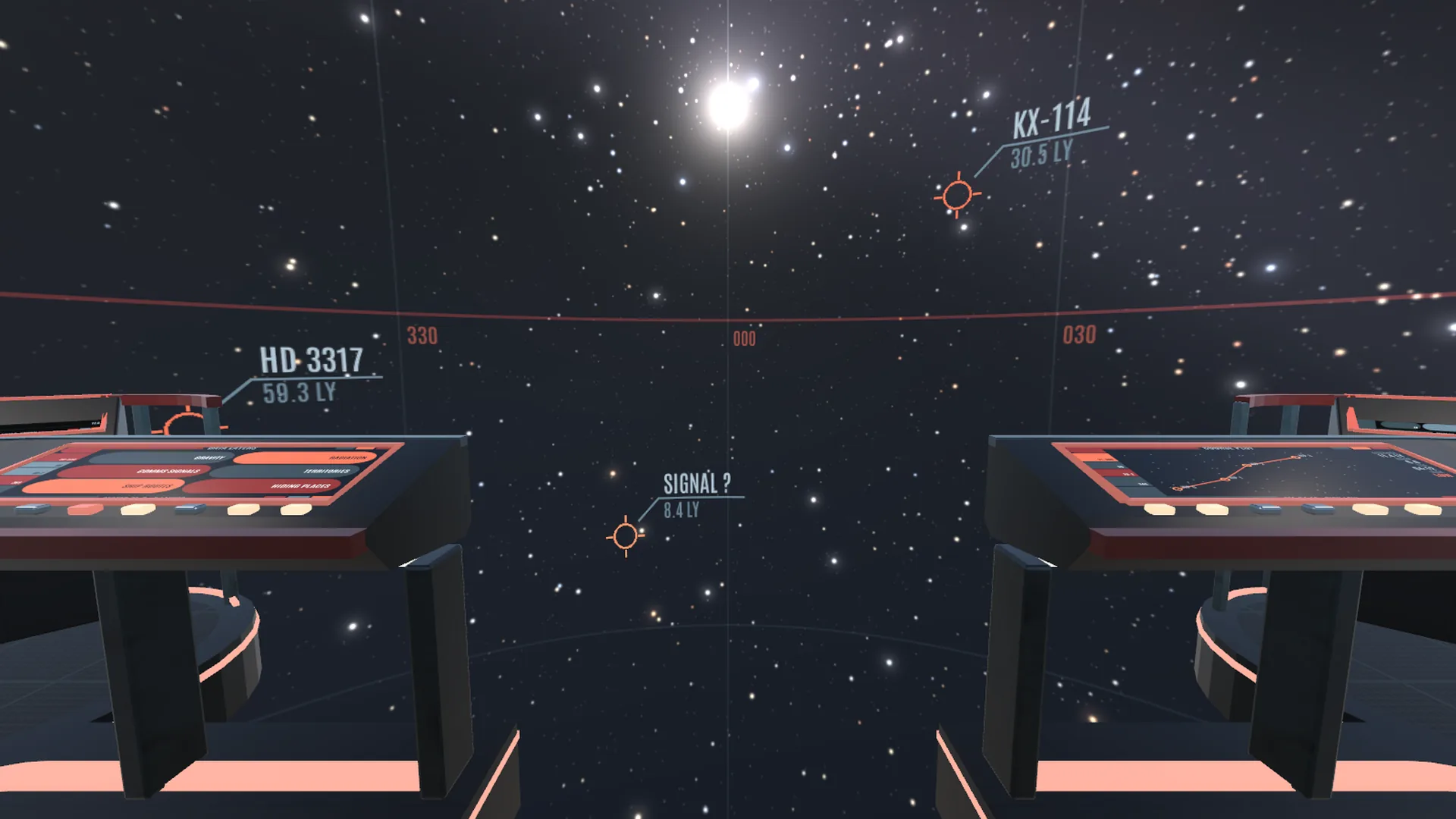
Linked to your headset
The website has no Meta login, so you link it with a code from the game. In the headset choose Menu → Simulator Editor → Link web editor. The game shows a six-character code and the address of this page. Type the code in here and the editor knows it is you. The code works once and expires after ten minutes, and you can unlink the web editor from the game menu at any time.
That is why only owners of the game can write programs, and why every program carries the name of its author.
What the AI keeps an eye on
- The shape of a good mission. A short routine, a clock that runs from the investigation at the latest, every key fact reachable in at least two ways, and a turning point with an option that only the investigation unlocks.
- Only what the game has. Existing species, ships, places, voices and 3D models. If something is missing, you can ask for it.
- A world of your own. Names from other films, series and games are swapped for something original, and a list of banned names catches the rest.
- Your language. Write in English or Czech. The AI writes the English lines the crew speaks and the Czech subtitles.
Aboard the IKAREE: simulator programs
Approved programs go into the simulator library. You open it from the computer in the captain's quarters or from the menu, and the program runs on the bridge.
- Begin and end. The computer announces the program and its author, and for a moment the bridge shows the simulator grid. When you end the program, by voice or from the menu, the grid returns and you are back off duty.
- The crew are holograms. Your officers with the same names, voices and character, but without memory. Nothing carries over: crew trust and the state of the ship stay as they were.
- Not canon. A program may bend the lore or even "kill" the crew. It is a story, not the story.
- The library. Name, author, length, genre (exploration, crisis, diplomacy, mystery), player ratings, and a Featured tag for the author's picks.
The best programs can become canon: the game's author adapts one into a real episode of the campaign, with the writer credited.
Every program is read by a person
Nothing reaches the game without the approval of the game's author. An AI review helps with a short summary, strengths and weaknesses, conflicts with the lore and the numbers from the test runs: how soon the trigger comes, how many decisions there are in the first ten minutes, which endings players reach. Then the author approves the program, returns it with a note, edits it or declines it. Each author can have one program waiting for review and three drafts in progress.
Something missing?
You build from the game's library: species and portraits, ship types, planets and moons at real stars, voices, music and sounds. If your story needs something that is not there, say a frozen moon base, describe it as an asset request. The author either makes it, and it joins the library for everyone, or helps you fit the story to what already exists.
Rules for authors
- You are credited as the author. You give IKAREE a non-exclusive licence to use, adapt, translate and distribute the program in the game.
- No other brands or their characters, no real people, no sexual content, no hate and no instructions for causing harm.
- The author of the game can edit a program, leave it unpublished or withdraw it at any time.
- Drafts and chats will be stored in the EU and deleted with your account.
The full terms will be part of the legal pages before the editor opens.
Not decided yet
How the editor's AI time is paid for, whether authors get more than their name in the game, and when player ratings become public. We will say before the editor opens.
What a mission is made of
Behind the conversation, every mission in IKAREE is a single data file, not code. The story missions, including the demo mission Signature, are written this way today, and about 100 are planned. Every mission runs the same way:
- Routine. The ship is on duty at a real star from the catalogue.
- The trigger. A signal, a wreck, a ship on the run. The author decides whether it can be refused.
- Investigation. Contacts to scan at three levels of detail, hidden facts that come out when the captain asks the right question.
- The decision. The captain says what to do in their own words. The crew recognises the intent.
- Endings and the log. Several endings, a captain's log entry, and memories your officers keep.
The AI crew only speaks and recognises what the captain means. What actually happens is decided by the mission file, so a program plays the way its author wrote it, every time.
{
  "id": "ep11_the_buoy",
  "title": "The Buoy",
  "location": { "star_name": "Tau Ceti" },
  "captain_intents": [
    { "id": "repair_buoy",
      "description_en": "Captain decides to repair the buoy.",
      "examples_en": ["Fix the buoy.", "Repair its prediction module."] },
    { "id": "leave_it",
      "description_en": "Captain decides to leave the buoy alone.",
      "examples_en": ["Leave it.", "Not our business."] }
  ]
}Your ship lives on
This is where IKAREE is going. Write a story and the ship in it does not vanish when the mission ends. It keeps its own life in the galaxy: it travels, it remembers, and other captains will run into it, hail it, help it or regret it. Over time the Milky Way of IKAREE fills with the stories of its players.
Until then
Play the demo mission Signature to see what a mission feels like from the captain's chair. Would you like to be one of the first authors? Write to us.
In development
Take the chair.
The free IKAREE demo comes out on 16 November 2026 on the Meta Horizon Store. The full game will follow.
- Meta Quest 3 / 3S, standalone, no PC needed
- Walk the ship in your room, or play seated; internet and microphone required